You might've heard the news. The FDA just approved the first new sunscreen ingredient in over 25 years — and it's a big deal for everyone who cares about sun protection.
Here's what you need to know, what it means for your routine, and how to navigate your SPF choices right now.
What Is BEMT?
BEMT stands for Bemotrizinol — a chemical UV filter that has been used safely in sunscreens across Europe and Asia since 1999. If you've ever used a K-beauty SPF or picked up a French pharmacy sunscreen on vacation and thought "why doesn't this exist in the US?" — bemotrizinol is a big part of the reason those formulas felt so different.
The FDA finalized its approval of bemotrizinol, the first new ultraviolet filter in more than 25 years, deemed a safe and effective active ingredient in U.S. sunscreens.
Here's the quick breakdown:
- BEMT = Bemotrizinol — a chemical (non-mineral) UV filter
- Safe and effective — data submitted to the FDA confirms that at concentrations up to 6%, bemotrizinol is minimally absorbed through the skin, with average absorption levels below the concentration the FDA considers indicative of systemic exposure
- 27 years of global use — used in Europe and Asia since 1999 under brand names including Tinosorb® S and Parsol® Shield
- Photostable — unlike avobenzone, BEMT doesn't break down in sunlight, meaning it stays effective all day
- Strong UVA protection — it specifically closes the UVA gap that has long been a weakness in American sunscreens
Why Is This Such a Big Deal?
The core issue is UVA protection. UVA rays are the ones responsible for deep skin damage — premature aging, collagen breakdown, and a primary contributor to skin cancer. Traditional U.S. sunscreens excel at blocking UVB rays, which cause visible sunburns, but routinely fail to shield against deep-penetrating UVA rays.
Until now, the only non-mineral ingredient in US sunscreens that provided meaningful UVA coverage was avobenzone — and avobenzone is chemically unstable, meaning it breaks down when exposed to sunlight. BEMT solves that problem with a stable, long-lasting UVA filter that doesn't degrade.
Even with bemotrizinol added to the mix, U.S. sunscreen formulators will have access to 16 approved UV filters — while European formulators have access to approximately 30. So while this is a meaningful step forward, there's still work to be done.
So — Is BEMT Better Than Mineral SPF?
Here's the honest answer: it depends on your skin and what matters most to you.
Whether a chemical or mineral SPF is the best choice is highly personal. Both protect. Both have trade-offs. Here's how they compare:
Mineral SPF ✓✓✗
✓ Physical filter — sits on top of skin and physically deflects UV rays rather than absorbing them
✓ Can be reef-safe — zinc oxide is one of the most reef-friendly UV filters available, and when formulated without oxybenzone and octinoxate, mineral sunscreens are ocean-safe
✗ Can leave a white cast — this is the biggest complaint about mineral SPF, though it depends entirely on the formula. Modern mineral formulas like ours are engineered to minimize white cast significantly
Best for: Sensitive skin, rosacea, acne-prone skin, babies and children, people who want the most stable and balanced UVA/UVB protection, and anyone who prefers a physical barrier
Chemical SPF (including BEMT) ✓✓✗
✓ Absorbs into skin — chemical filters work by absorbing UV rays and converting them to heat, which means they go on invisibly
✓ Clear — no white cast — this is the biggest advantage of chemical SPF, especially for deeper skin tones where mineral formulas have historically been more visible
✗ Can sometimes feel oily — depending on the formula, some chemical SPFs have a heavier or greasier feel, particularly in heat and humidity
Best for: People who have struggled with white cast, those who prefer an invisible finish, and anyone who wants the lightest possible texture on skin
Where Does MDSolarSciences Stand?
At MDSolarSciences, our foundation has always been mineral SPF. EWG's top recommendation for daily use remains mineral sunscreens formulated with zinc oxide, which provide the most stable and balanced broad-spectrum UVA and UVB protection currently available.
Our formulas are built on 100% mineral actives — zinc oxide as the core UV filter — engineered by our founder Dr. Robert Friedman, one of the pioneers of the ABCDE's for melanoma detection. Every formula we make is dermatologist-developed and rooted in skin cancer prevention.
That said, we believe in empowering you to make the right choice for your skin. The best sunscreen is always the one you'll actually wear — every single day.
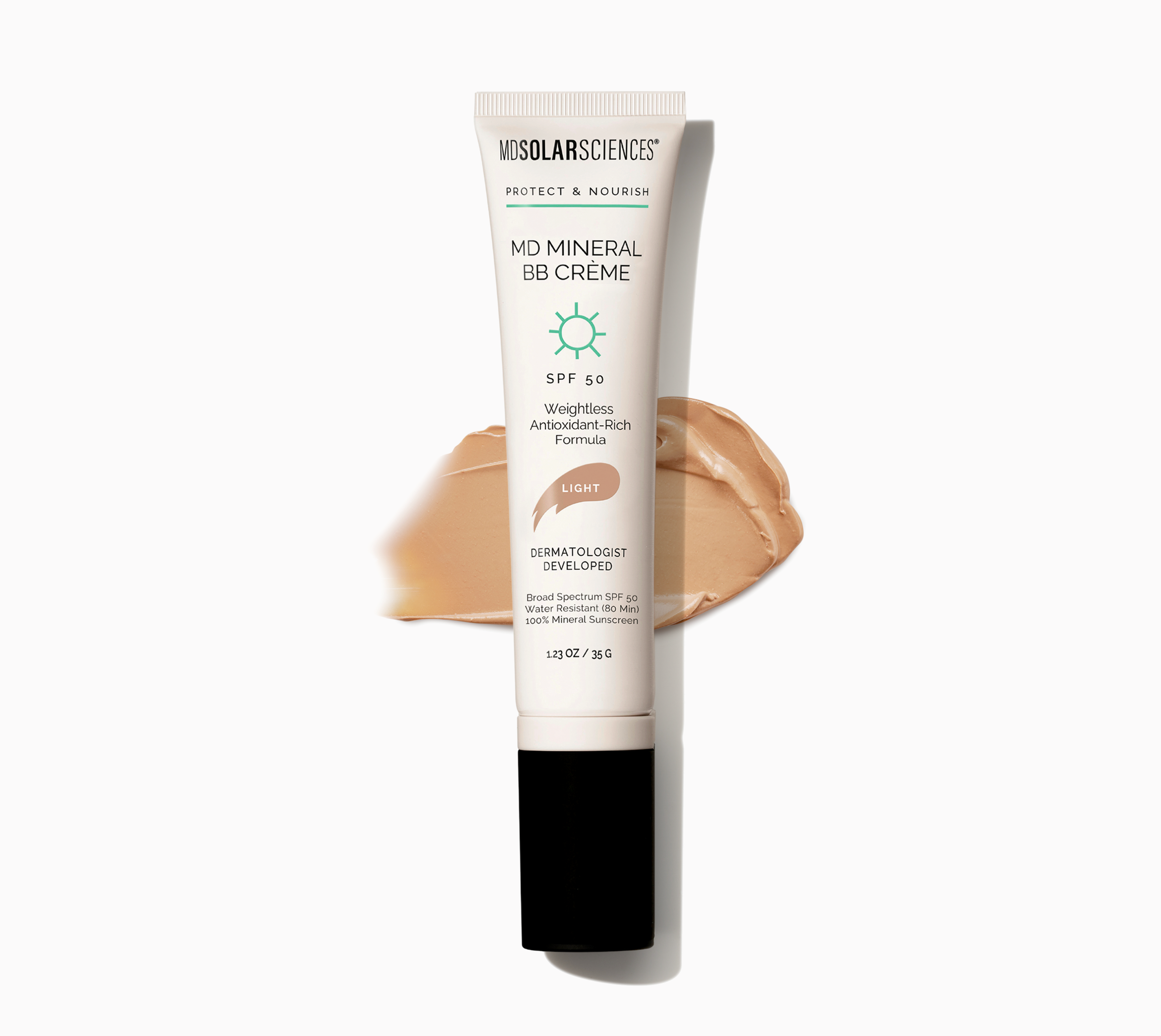
For mineral SPF: Our Mineral Crème SPF 50, MD Mineral BB Crème SPF 50, and Mineral Tinted Crème SPF 30 are formulated to minimize white cast while delivering maximum broad-spectrum protection.
For kids: Our Mineral KidCrème SPF 50 and Mineral KidStick SPF 40 use 100% mineral actives that are safe from 6 months+ and gentle enough for the most sensitive skin.
What to Do Right Now
BEMT products won't hit US shelves immediately. Today's approval of bemotrizinol triggers 18 months' exclusive marketing rights in the U.S. of Parsol Shield, a proprietary bemotrizinol formulation. After that period, other manufacturers may use it in their formulations, driving broader availability and more competitive pricing.
In the meantime, here's how to choose the best sunscreen for your skin today:
If you want maximum protection and have sensitive skin: Choose a mineral SPF with zinc oxide. It's the most stable, most trusted, and most dermatologist-recommended option currently on shelves.
If white cast has stopped you from wearing SPF: Look for modern mineral formulas engineered for minimal white cast — or a hybrid formula. The right formula makes all the difference.
For your kids: Mineral actives are still the recommendation for babies and children. Safe, gentle, and effective from day one.
The most important rule of all: The best SPF is the one you actually wear. Daily. Rain or shine. Indoors and out. ☀️
Explore MDSolarSciences' full collection of dermatologist-developed SPF skincare at mdsolarsciences.com
Sources: Environmental Working Group (EWG), FDA Press Announcement June 2026